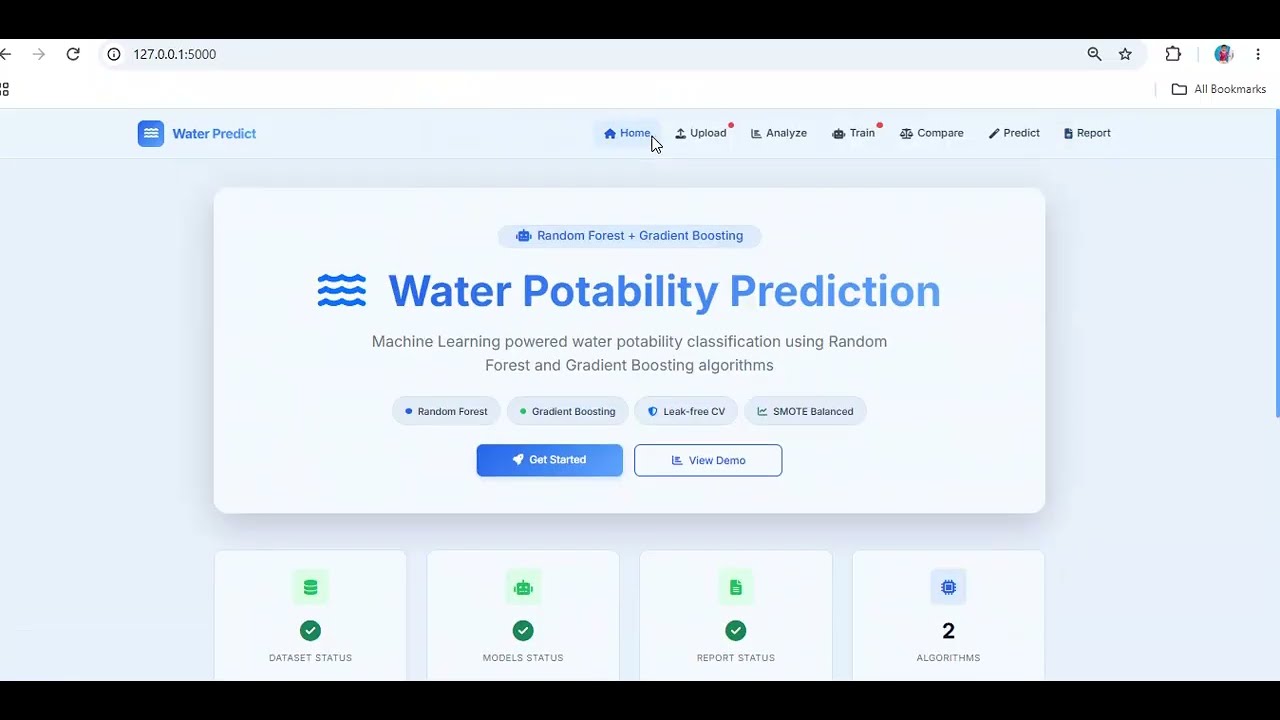
Water Potability Prediction Using Machine Learning
The Water Potability Prediction Using Machine Learning system is a comprehensive machine learning solution that classifies water samples as potable or non-potable using 9 physicochemical parameters. This project is ideal for B.Tech, MCA, CSE, and engineering students as their final year project. It uses advanced ensemble algorithms like Random Forest and Gradient Boosting with SMOTE to achieve 96.50% accuracy.
The system leverages 9 parameters including pH, Hardness, Solids, Chloramines, Sulfate, Conductivity, Organic Carbon, Trihalomethanes, and Turbidity, plus engineered features like pH-Hardness ratio and Conductivity-Solids ratio. It provides interactive visualizations, feature importance analysis, model comparison, and real-time water potability prediction to help in rapid water quality assessment and public health protection.
- Binary Water Potability Classification
- Random Forest (96.50% Accuracy)
- Gradient Boosting (96.28% Accuracy)
- SMOTE for Class Imbalance
- Feature Engineering (Ratio Features)
- Feature Importance Analysis
- Real-time Water Potability Prediction
- Model Performance Comparison
- 5-Fold Stratified CV
- Flask Web Application
Algorithms Used
Methodology & Workflow
Water quality dataset with 3,276 samples and 9 parameters
Median imputation, IQR outlier removal, feature scaling
Ratio features, squared features for non-linear effects
Random Forest & Gradient Boosting with SMOTE pipelines
Accuracy, Precision, Recall, F1-Score, ROC-AUC, 5-fold CV
Flask web app for real-time water potability prediction
Model Performance Comparison
| Metric | Random Forest | Gradient Boosting | Best |
|---|---|---|---|
| Accuracy | 0.9650 | 0.9628 | Random Forest |
| Precision | 0.9650 | 0.9636 | Random Forest |
| Recall | 0.9650 | 0.9628 | Random Forest |
| F1-Score | 0.9648 | 0.9625 | Random Forest |
| ROC-AUC | 0.9903 | 0.9878 | Random Forest |
| CV Mean (5-Fold) | 0.9852 | 0.9812 | Random Forest |
Project Package Includes:
Scan & Pay with UPI
Submit Your Payment
Thesis & Dissertation
Complete thesis writing, research guidance, and formatting support
Expert HelpAssignment Help
Quality assignment writing, editing, and proofreading services
100% OriginalPhD Research
Research proposal, literature review, data analysis & publication
PhD LevelProject Guidance
Academic projects, mini projects, and final year project support
Hands-on